Three trucks,
one tight route sheet.
Freight is a service we run ourselves because outsourcing it introduced too many broken valves. Two box trucks and a 26-foot straight run out of the yard daily — consolidated loads, biodiesel blends where available, and the driver who signs for your tanks is on our payroll.
Skip the phone tag. Leave a note — we'll reply by email.
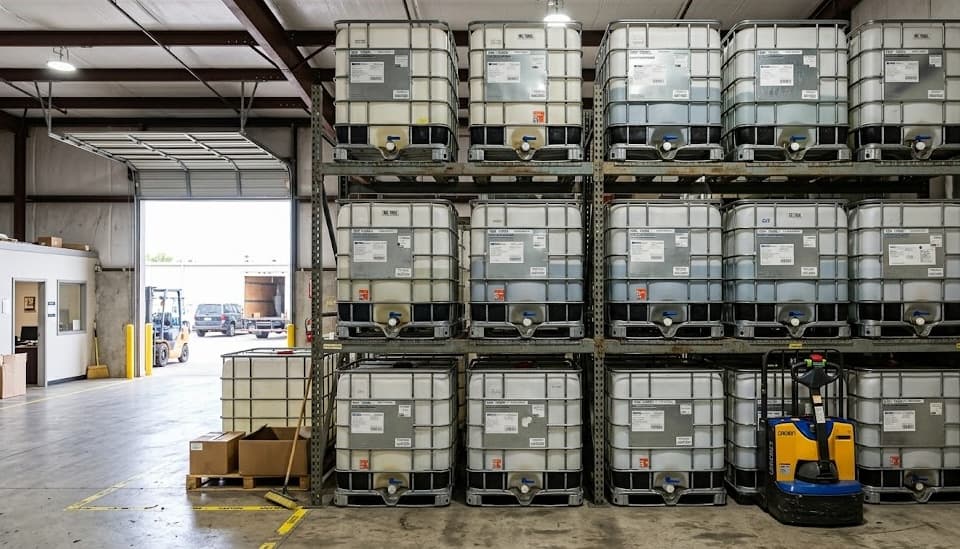
Gate-open to gate-closed in under an hour.
The staging aisle between Bay A and the warehouse gate. Pallets come off the forklift in the order they'll go onto the truck — last off the truck lives at the back of the bay, first off rides by the door. A typical outbound run loads in forty minutes, most of it spent on paperwork, not on muscle.
Route zones & timing
Four freight corridors,
fifty towns.
Ninety-four percent of our route miles fall on four interstate spines. We built the schedule around them because consolidating loads onto a single corridor cuts per-tote freight cost by roughly a third. If your pickup or delivery sits on one of these, your quote gets better.
I-79 North & South
Tue / Thu (South), Wed / Fri (North)The backbone. Waynesburg, Washington PA, Canonsburg, Pittsburgh, Cranberry, Butler, Franklin, Meadville. Loads consolidate at the yard and roll out pre-dawn.
I-70 East & West
Mon (West), Thu (East)Cross-state east–west. Picks up the Wheeling / Steubenville / Moundsville axis and extends into central PA for central-market deliveries.
I-76 / PA Turnpike
Tue / FriOhio swing. Akron polymer houses, Youngstown service yards, and the Warren / Niles corridor. We run the 26-footer here for scale.
I-77 / OH-7 South
Every other WedThe southern loop into the mid-Ohio valley. Brine customers, a detergent blender in Belpre, a handful of greenhouse accounts.
Off-corridor stops are possible but cost more per mile because they don't consolidate. If your address is more than 20 miles off a spine, we'll flag it on the quote.
How we actually
strap a tote down.
Every load leaves the yard under the same securement protocol, whether it's three empties on the small box truck or twenty-two filled on the 26-footer. The rules come straight from 49 CFR 393 Subpart I with a few additions we learned from the freight we've broken ourselves.
- One tote, two straps, minimum. 3,000-lb WLL ratchet straps across the cage, corner-protected. Empties get one strap across two stacked tanks; filleds always get two.
- Stack height limit. Empties stack two high for cardinal totes, one high for anything with a pre-existing cage bend. Filled totes never stack, period.
- Pre-trip inspection. Every driver does a tote-by-tote cap, valve, and cage-weld check before the liftgate comes up. Takes 6–8 minutes on a full load and it has caught a loose valve more than once.
- No hazmat on mixed loads. If one tote requires a placard, the entire truck runs as hazmat for the day. We rarely mix — usually hazmat loads get their own dispatch.
- Post-trip wipe-down. The decks get a broom and a damp rag after every freight run. Cross-contamination between prior contents is the one thing that ends a wash bay's day.
- Box A · 2020 Isuzu NPR-HD
- 16 ft deck · 14,500 GVW
- Box B · 2018 Freightliner M2-106
- 20 ft deck · 25,950 GVW
- Straight · 2022 Peterbilt 337
- 26 ft deck · 33,000 GVW
- Biodiesel blend (when available)
- B20 from a local Slippery Rock supplier
- Average annual idle reduction
- ≈ 740 hours via APU
- Insurance (primary auto)
- Commercial CSL plus umbrella policy
- Cargo coverage per load
- Carried on every dispatch, limits available on request
- Driver HOS software
- Samsara ELD, audited monthly
COIs available on request. We name the consignee as additional insured at no charge for standing accounts.
How we dispatch
a weekly run.
The schedule lives on a paper wall calendar in the dispatch office because we tried software three times and kept going back. Here's the rhythm that actually works for a three-truck operation our size.
- Mon 6:30 AM
- Straight truck · I-70 West (Wheeling, Bedford)
- Tue 5:45 AM
- Box B · I-79 South corridor
- Tue 10:00 AM
- Straight truck · I-76 Ohio loop
- Wed 6:00 AM
- Box A · Local Zone 1 drops (Allegheny)
- Wed 7:30 AM
- Box B · I-79 North corridor
- Thu 6:00 AM
- Straight truck · I-70 East (Somerset, Bedford)
- Thu 8:00 AM
- Box A · Local buy-back pickups
- Fri 6:00 AM
- Box B · I-76 Ohio repeat (if backlog)
- Fri afternoon
- Yard day · tire, oil, DOT checks
Holiday weeks collapse to Mon/Wed/Fri. Inclement weather pushes routes one day rather than cancelling — drivers would rather run Saturday than idle.
What makes a
good pickup site.
We've loaded totes off loading docks, out of barns, off rail sidings, out of storage tents in February. The good sites have a few traits in common; the hard ones share a different set. A short honest guide:
- · Paved access within 30 ft of the totes
- · Site contact available from arrival to load-out
- · Forklift on site OR totes pre-staged flat for liftgate
- · At least one overhead clearance of 13′6″ for the straight truck
- · Clearly labeled prior contents on each pallet group
- · Soft ground — mud season makes liftgates sink
- · Narrow gate, tight turns under 55 ft radius
- · Multi-tenant yard with locked overnight gate
- · Drivers' restroom unavailable on site (DOT issue)
- · Totes stacked two high without corner protection
Rarely, and only for existing accounts. Past the 300-mile mark we hand off to a vetted carrier with documented cargo insurance. We don't mark up brokered freight.
Yes — it's about a quarter of our deliveries. We'll send the 16-foot box with a liftgate. You'll need 12 feet of clear curb and an adult with signing authority at the address.
On consolidated corridor runs, not really — the rate already reflects the consolidation discount. Off-corridor, a firm delivery window can move the number by 10–15%.
Driver photographs each tote on load and unload. Any damage between the two photos is on us — we replace or credit within the invoice cycle.