Reconditioned totes —
a second first life.
These are used totes that we've run through the full reconditioning bay: triple-rinse, hot-caustic, pressure-tested, optionally rebottled with a new HDPE inner. Every unit ships with fresh UN31A paperwork and a ledger entry.
Skip the phone tag. Leave a note — we'll reply by email.
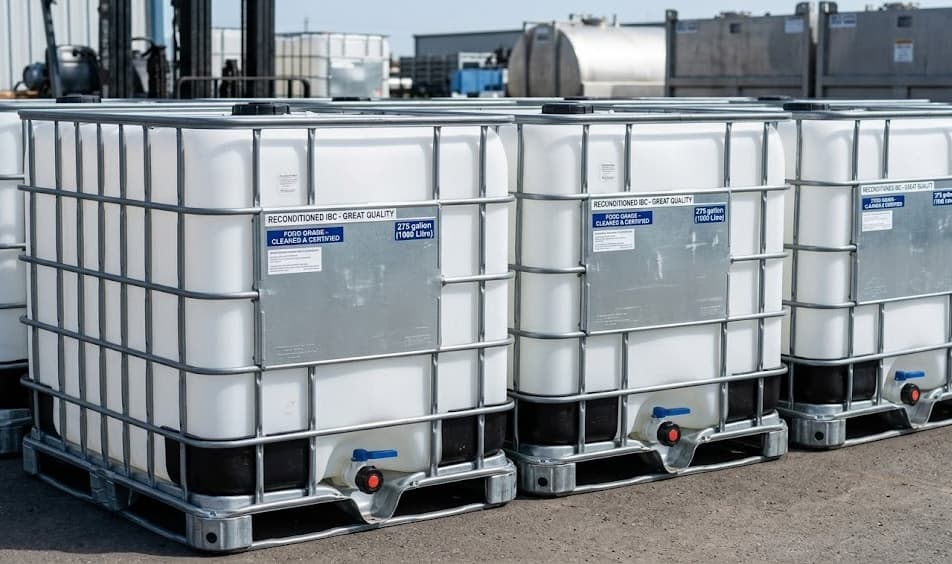
Food-grade. Cleaned. Certified. Labelled by hand.
Straight out of the wash bay, dried in the 48-hour forced-air tunnel, re-labelled with the current reconditioning date, and wheeled to the south lot for dispatch. The blue sticker on the side is not decorative — it links back to a ledger entry with the wash operator's initials, the chemistry used, and the UN31A retest timestamp.
The reconditioning steps, in order
- 01
Receive & tag
Every tote gets an ID on arrival. Prior contents are logged from the label or a short conversation with the seller.
- 02
Triple rinse
Hot caustic → detergent → potable water. Waste is captured, treated, and drained to an industrial sewer connection.
- 03
Inspect & swap
Valve, gasket, and cap replaced if sub-standard. Cage straightened or swapped. Pallet reviewed.
- 04
Pressure test
Hydrostatic UN31A re-certification. Paperwork attaches to the tank ID and follows it out the door.
Standard reconditioned
Same HDPE bottle, cleaned and re-tested. Our best value for anything other than food contact. 90% of customers land here.
- · Fresh UN31A cert · 1 year
- · Replaced valve and gasket (if worn)
- · From $175.00/unit
Rebottled food grade
Original cage + pallet, new virgin HDPE inner bottle, full food-grade paperwork. For operations that need FDA-compliant contact surfaces without buying brand new.
- · Virgin HDPE inner · FDA 21 CFR 177.1520
- · Fresh UN31A cert · 1 year
- · From $245.00/unit
Inside the triple-rinse
The phrase gets used loosely in our trade. Here's the specific protocol we run on every reconditioned unit, measured and logged so you can trust the outcome.
- 01Stage 1 · Caustic cycle180 °F sodium-hydroxide solution (1.5–2.0% by mass), circulated 12 minutes through a spinning spray head that hits every interior wall. Handles fats, sugars, most organic residue, and softens mineral scale.
- 02Stage 2 · Acid cycle (when needed)Phosphoric or citric acid rinse at 140 °F, 6 minutes. Only applied when prior content was dairy, plating chemistry, or scaled water. Neutralized downstream before drain.
- 03Stage 3 · Detergent flushFood-grade non-ionic surfactant, 110 °F, 8 minutes. Carries any broken residue to drain and leaves no film on the HDPE.
- 04Stage 4 · Potable rinseMunicipal water at line temperature, 10 minutes, until conductivity at the drain matches inlet within ± 5 µS/cm.
- 05Stage 5 · Air-dry & inspectFiltered shop air through the discharge valve for 20 minutes. Interior then lit and visually checked. Any cloudiness or residue sends it back to Stage 1.
What the UN31A re-cert actually proves
Every reconditioned tote we ship carries a fresh UN31A / Y stamp. The certification is doing real work, not decorating the cage.
Tote loaded to 1.8x operating weight for 24 hours to prove cage and pallet won't yield under warehouse stacking pressure.
Bottle pressurized to 1.5x operating pressure (typically 15 psig) and held. Any weep at seams or valve fitting is an automatic fail.
Internal pressurization at 2.9 psig, all openings sealed. The tote is submerged in a soap bath; any bubble path is a reject.
At least one unit per batch is dropped corner-first from 31 inches onto a steel plate. Break it and we revisit the whole batch.
The resulting plate is valid for 12 months after re-cert for liquid service, and we attach the test report PDF to the tank's ledger entry, searchable by ID.
Reconditioned vs rebottled — when to pay up
| Attribute | Standard reconditioned | Rebottled food grade |
|---|---|---|
| HDPE bottle | Original, triple-washed | Virgin, factory-new |
| Contact surface eligibility | Non-food industrial only | FDA 21 CFR 177.1520 |
| Cage & pallet | Original, straightened & cleaned | Original, straightened & cleaned |
| Valve | Replaced if wear noted | Food-grade butterfly, FDA gasket |
| Documentation | Re-cert + ledger entry | Re-cert + ledger + bottle lot letter |
| Lead time | 48 hours | 72 hours |
| Best for | Glycol, fertilizer, biodiesel, water | Maple, honey, beverage, cosmetics |
We think of rebottling as the honest answer to "I need new" when a customer only actually needs a new contact surface. The steel cage of a 2016 Schütz is every bit as good as one made last month — there's no reason to put it in the scrap pile when a fresh bottle does the whole job at a fraction of the new-tote cost.
Which elastomer, for which fluid.
The valve body is usually the right polypropylene by default. The part that fails first is the gasket. Match the elastomer to the fluid and the reconditioned tank will outlast the project.
| Elastomer | Strong for | Weak for |
|---|---|---|
| EPDM (std) | Water, glycols, weak acids, soaps, rain capture | Oils, fuels, most hydrocarbons |
| Buna-N (NBR) | Diesel, biodiesel, vegetable oils, DEF | Ozone exposure, strong acids |
| Viton (FKM) | Solvents, aromatic hydrocarbons, strong acids | Hot amines, steam |
| PTFE (envelope) | Virtually anything chemical | Price, and it's stiffer to seat |
| Silicone | Food contact, FDA 21 CFR 177.2600 | Abrasives, high pressure |
Questions we hear most
Close, but we reserve 'reconditioned' for units that pass a fresh UN31A pressure test with paperwork. Refurbished in the broader trade just means wiped clean and made pretty. Ours is always the former.
Roughly 60 gallons across all five cycles. Our wash loop captures and treats 100% of it on-site — we discharge to an industrial sewer connection under a McKees Rocks Sanitary Authority permit.
Yes. We run a job-lot reconditioning service priced per unit by quote with a 20-tote minimum. You drop, we wash-test-ledger-return. See the Services page for the intake form.
In our experience, yes — provided you keep the bottle-lot certificate and the UN31A test report we ship with it. Auditors want document continuity more than they want mill-fresh. We pre-assemble the binder for you.
90-day functional warranty — leaks, valve failure, cage weld crack, any UN31A reversal. We'll swap it on the spot and log the swap to the ledger. Cosmetic wear (fade, paint chips, pallet scuffs) is not covered.
The re-cert is 12 months; the cleanliness is good indefinitely if the tote stays sealed. We've seen reconditioned tanks run ten years of food-adjacent use and still hold pressure. UV and freeze cycles shorten that fast — keep it shaded.