Used IBC Totes —
the workhorse shelf.
Rinsed, graded, logged, and stacked. Our largest product category. We keep 300–500 used 275-gallon units on hand at all times, plus a smaller rotating stock of 330s and the occasional oddball 110 or 550.
Skip the phone tag. Leave a note — we'll reply by email.
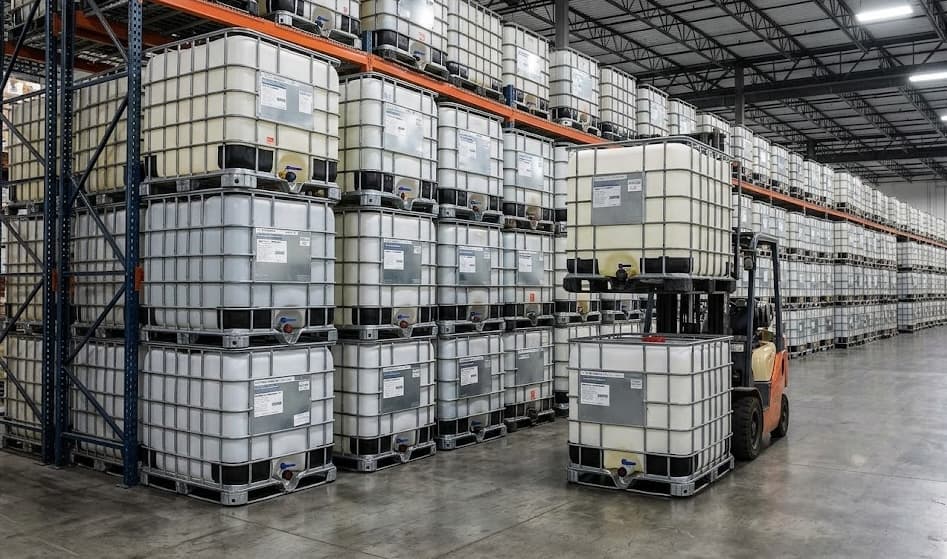
300 to 500 units, stacked three high, every day of the year.
The workhorse shelf. Used 275s and 330s live on the north wall of Bay B, three pallets high, organized by grade from the forklift alley out. A tote's label reads at eye height from the operator's seat — cage, grade letter, intake ID, and the previous-contents tag. No tote leaves this aisle without an audit entry.
- Dimensions
- 48″ × 40″ × 46″
- Empty weight
- 125 lb empty
- Price
- $85.00/unit
- Dimensions
- 48″ × 40″ × 53″
- Empty weight
- 152 lb empty
- Price
- $135.00/unit
- Dimensions
- 31″ × 28″ × 38″
- Empty weight
- 62 lb empty
- Price
- $45.00/unit
How our grading works
Every incoming tote gets checked on the receive line for four things: cage integrity, valve condition, residue type, and HDPE translucency. We grade based on the worst of those four.
- Grade A · Food
- Previous contents were a food-grade substance with full label documentation. Triple-rinsed, UN31A current, no residual cloudiness. Shippable as food contact. Most expensive.
- Grade B · Industrial
- Previous contents were a known non-hazardous industrial fluid — glycols, soaps, detergents, fertilizers. Rinsed once, integrity intact. Best value by far.
- Grade C · Raw
- Functional tank, unrinsed or with minor aesthetic wear. Perfect for non-potable water, landscaping, ballast, or customers planning a deeper clean themselves. Cheapest.
Not sure which grade fits your job? Email the yard with what you plan to store — we'll tell you straight. Full system is on the Grading page.
What to check the minute it lands.
Walk the unit with these points in hand. If anything fails, call us before you unload further — we'd rather trade out a part on the spot than argue later.
- Cage weld jointsRun a finger along the lower four horizontal tubes. Any cracked weld goes back on the truck. Minor surface rust is fine and normal.
- Bottle cornersPress each bottom corner with your hand. A sound bottle resists. A stress-whitened corner that gives under thumb pressure means internal fatigue — reject.
- Valve bodyOpen and close the 2″ ball valve twice. Should click firmly. Wobble in the handle indicates a worn valve stem; we'll swap it free inside 30 days.
- Gasket lipPull the 6″ cap and look at the EPDM gasket. Flat, supple, and seated = good. Stiff, cracked, or flaking = replace before first fill.
- UN31A plateShould show a re-cert date within the last 12 months for food or reconditioned units. Used industrial grades carry the original factory plate.
- Pallet interfaceSlide a tape measure through both fork pockets. Both should clear 3 inches for a standard forklift tine.
- Translucency checkHold a work light on one side. If you can read a rough outline of your hand through the opposite wall, the HDPE is still good.
Where our used totes come from
Unlike most resellers, we don't buy a mystery mix at auction. Every incoming unit has a paper trail we read before it gets off the truck, and that trail drives the grade. The short version of our supply:
Local breweries, syrup houses, honey packers, juice co-packers. These become our Grade A pipeline.
Industrial cleaners, glycols, pool chemistry, fertilizers. Strong candidates for Grade B after a hot rinse.
Mid-Atlantic manufacturers closing out a drum program. Mixed priors, honest documentation, usually one big drop.
When a yard in OH or NY retires stock, we'll buy the cleaner half and let them scrap the rest.
The numbers behind the tank.
These specs apply to the standard 275-gallon composite IBC we stock most deeply. Deviations by manufacturer exist — ask if your design envelope is tight.
| Usable capacity | 275 US gallons (1,040 L) |
| Fill capacity | 285 US gallons (1,078 L) |
| Bottle material | Blow-molded virgin or post-consumer HDPE |
| Bottle wall thickness | 2.3 mm (sidewall), 3.1 mm (corners) |
| Cage construction | Welded galvanized steel, 56 tubes on a Mauser reference unit |
| Pallet types | Wood-composite (std), all-steel, plastic HDPE |
| Stacking | Two high filled, four high empty |
| Typical load rating | 2,200 lb liquid (density 1.0) |
| UN/DOT rating | UN31A/Y — solids and most non-hazardous liquids |
| Temperature window | −40 °F to +140 °F (−40 °C to +60 °C) |
| Standard discharge | 2″ buttress male, with ball or butterfly valve |
| Standard fill | 6″ screw cap, vented option available |
| Empty weight | 125 lb (composite pallet), 185 lb (all-steel) |
| Footprint | 48″ × 40″ — pallet-perfect |
Regulatory notes we keep handy
A used tote's original UN31A plate is valid from the factory date for 2.5 years for a solids pack and 5 years for liquid. Hydrostatic retest extends it another 2.5 years. We re-cert on request for a modest per-tank labor charge.
You can reuse an IBC for a non-hazardous fluid without re-testing if the prior content was compatible and the tank passes visual inspection. For hazmat service the retest window is strict — we recommend new or reconditioned, not used, for any DOT-regulated shipment.
The FDA recognizes virgin HDPE as an approved food contact surface. A used tote's HDPE can lose that status depending on prior contents. Grade A preserves it by documentation; rebottling restores it by swap. Grade B and C are not food-contact eligible no matter how well you clean them.
Used vs reconditioned vs new — at a glance.
| Attribute | Used A/B/C | Reconditioned | New |
|---|---|---|---|
| Interior cleaning | Single rinse (B/C) · triple (A) | Hot caustic + triple rinse | Factory sealed |
| Valve / gasket | Inspected, kept if sound | Replaced if worn | New |
| UN31A paperwork | Original plate | Fresh 12-mo re-cert | Factory cert |
| Food-grade eligible | Grade A only, with caveats | Only if rebottled | Yes |
| Typical lead time | Same day | 48 hrs | 2–5 days from stock |
| Warranty / goodwill | 30-day functional | 90-day functional | 1-year factory |
The grade of used you need depends on content risk and documentation needs. The jump from Grade B to reconditioned is usually about paperwork, not about cleanliness — a Grade B tote that previously held glycerin is often cleaner than a reconditioned unit that was caustic-hit in the bay an hour ago. Pick by audit trail, not by instinct.